The process management module. More...
Typedefs | |
| typedef struct osapi_proc_id_S | t_proc_id |
| The Process identity type. | |
| typedef struct osapi_proc_info_S | t_proc_info |
| The process information type. | |
| typedef struct osapi_proc_libinfo_S | t_libinfo |
| Define the library info type. | |
| typedef struct osapi_proc_resources_S | t_proc_resources |
| The process resources type. | |
| typedef union osapi_proc_upid_U | t_upid |
| Define the Unique PID. | |
Functions | |
| t_status | proc_module_supported (void) |
| Is PROC module supported in the platform. More... | |
| t_status | proc_buffer_allocate (size_t bufsize, t_buffer *buffer) |
| Allocate memory in the HEAP using a buffer. More... | |
| t_status | proc_buffer_reAllocate (t_size bufsize, t_buffer *buffer) |
| Resize buffer memory. More... | |
| t_status | proc_buffer_deallocate (t_buffer *buffer) |
| Deallocate buffer memory. More... | |
| t_status | proc_buffer_getCapacity (const t_buffer *buffer, t_size *size) |
| Get the buffer capacity. More... | |
| t_status | proc_buffer_getData (const t_buffer *buffer, void **data) |
| Get the buffer (naked) memory address. More... | |
| t_status | proc_buffer_getSize (const t_buffer *buffer, t_size *size) |
| Get the current buffer memory usage. More... | |
| t_status | proc_buffer_setSize (t_size size, t_buffer *buffer) |
| Set the current buffer memory usage. More... | |
| t_status | proc_buffer_copy (const t_buffer *source, t_buffer *target) |
| Copy two buffer memories Buffers cannot overlap in any way (this generates an error) More... | |
| t_status | proc_buffer_copyFrom (const t_buffer *source, t_size targetSize, void *target) |
| Copy from a buffer to a naked/raw memory location. More... | |
| t_status | proc_buffer_copyTo (const void *source, t_size sourceSize, t_buffer *target) |
| Copy from a naked/raw memory into a buffer memory. More... | |
| t_status | proc_id_get (t_pid *pid) |
| Get the current process ID. More... | |
| t_status | proc_id_getParent (t_pid pid, t_pid *ppid) |
| Get the parent process ID. More... | |
| t_status | proc_id_getDescendents (t_pid pid, t_size tsize, t_size *csize, t_pid(*array)[]) |
| Get list of process IDs of children processes. More... | |
| t_status | proc_id_getUser (t_pid pid, t_uid *uid) |
| Get the User ID of the given process. More... | |
| t_status | proc_id_getGroup (t_pid pid, t_gid *gid) |
| Get the Group ID of the current process. More... | |
| t_status | proc_id_getSession (t_pid pid, t_pid *sid) |
| Get Session Identifier. More... | |
| t_status | proc_id_setSession (void) |
| Create a new Session. A new session is created with the current PID as being the Session ID. More... | |
| t_status | proc_id_getGroupMembers (t_pid pgid, t_size initialMembers, t_size *currentMembers, t_pid(*idList)[]) |
| Get the List of IDs of Process Group members. More... | |
| t_status | proc_id_getSessionMembers (t_pid sid, t_size initialMembers, t_size *currentMembers, t_pid(*idList)[]) |
| Get the List of IDs of Process Session members. More... | |
| t_status | proc_id_toString (t_pid pid, t_size size, t_char *string) |
| Convert a process ID to a C-String format. More... | |
| t_status | proc_id_fromString (t_char *string, t_pid *pid) |
| Convert a C-String into a process ID. More... | |
| t_status | proc_id_copy (t_pid source, t_pid *target) |
| Copy a source process ID to a target variable. More... | |
| t_status | proc_id_clear (t_pid *pid) |
| Reset ID to a default (and possible non usable) value. More... | |
| t_status | proc_uid_get (t_upid *upid) |
| Get the current process Unique ID A Process Unique ID is a unique incarnation of a process instance, i.e. no two processes will have the same UPID in the same node. More... | |
| t_status | proc_info_get (t_pid pid, t_proc_info *info) |
| Obtain raw process information This is the function call that allows clients to make a single call and obtain all raw process data. More... | |
| t_status | proc_info_getVirtualMemory (t_proc_info *info, t_size *size) |
| Extract the size of the process virtual memory from the process information. More... | |
| t_status | proc_info_getRealMemory (t_proc_info *info, t_size *size) |
| Extract the size of the process real memory, i.e. ram usage, from the process information. More... | |
| t_status | proc_info_getCPUConsumption (t_proc_info *info, t_size *size) |
| Extract the process CPU consumption (summary of user and system) from the process information. More... | |
| t_status | proc_info_getThreads (t_proc_info *info, t_size *number) |
| Extract the number of process kernel threads / LWPs from the process information. More... | |
| t_status | proc_info_getStartTime (t_proc_info *info, t_time *start) |
| Extract the process start time from the process information. More... | |
| t_status | proc_instance_create (t_proc *proc) |
| Create a new process instance. More... | |
| t_status | proc_instance_destroy (t_pid pid, int forced) |
| Terminate a running process. More... | |
| t_status | proc_instance_clone (int *isChild) |
| Clone the current process. More... | |
| t_status | proc_instance_isRunning (t_pid pid) |
| Is a process instance running. More... | |
| t_status | proc_instance_getState (t_pid pid, int *state) |
| Obtain the state of a given process. More... | |
| t_status | proc_instance_getChildStatus (t_pid *pid, t_proc_status *status) |
| Obtain status of a child process. More... | |
| t_status | proc_instance_getStatus (t_pid pid, t_proc_status *status) |
| Obtain a status of a process. More... | |
| t_status | proc_instance_getNumberOfDescendents (t_pid pid, t_size *number) |
| Obtain the number of children processes. More... | |
| t_status | proc_instance_getNumberOfGroupMembers (t_pid pgid, t_size *number) |
| Obtain the number of process group members. More... | |
| t_status | proc_instance_getNumberOfSessionMembers (t_pid sid, t_size *number) |
| Obtain the number of process session members. More... | |
| OSAPI_NORETURN void | proc_instance_terminate (int code) |
| Terminate the current process. It always succeeds. More... | |
| t_status | proc_instance_suspendExecution (void) |
| Suspend the execution of the current thread until an event occurs such as a signal in UNIX. More... | |
| t_status | proc_library_supported (void) |
| Is the load/unload of libraries supported in the platform? More... | |
| t_status | proc_library_load (char *path, char *options[], t_library *lib) |
| Load a library into the current process. More... | |
| t_status | proc_library_unload (t_library lib) |
| Unload a library from the current process. More... | |
| t_status | proc_library_getNumberOfLoaded (t_size *maxlibs) |
| Get the number of shared libraries loaded in the process. More... | |
| t_status | proc_library_getAllLoaded (t_size maxlibs, t_libinfo(*info)[]) |
| Get a list of name and version information for each process loaded/shared library. More... | |
| t_status | proc_library_getRelease (const t_char *name, t_size max, char *release) |
| Get the Release information of the named library. More... | |
| t_status | proc_list_allocate (t_size nItems, t_size itemSize, t_list *list) |
| Allocate memory in the HEAP for a list of items The "list" is implemented as an array of bytes. More... | |
| t_status | proc_list_reAllocate (t_size nItems, t_list *list) |
| Resize a list of items. More... | |
| t_status | proc_list_deallocate (t_list *list) |
| Deallocate list. More... | |
| t_status | proc_list_getCapacity (const t_list *list, t_size *size) |
| Get the list capacity in terms of allocated items. More... | |
| t_status | proc_list_hasCapacity (const t_list *list, t_size size) |
| Check if the list can store N items. More... | |
| t_status | proc_list_getRequiredCapacity (const t_list *list, t_size *size) |
| Get the required list capacity in terms of allocated items The required capacity is needed in case a list is not big enough to hold all elements. More... | |
| t_status | proc_list_getData (const t_list *list, t_size item, void **data) |
| Get the memory address of a given data item (of a list) More... | |
| t_status | proc_list_getSize (const t_list *list, t_size *size) |
| Get the current list usage in terms of number of items. More... | |
| t_status | proc_list_setSize (t_size size, t_list *list) |
| Set the current list usage. More... | |
| t_status | proc_list_setRequiredCapacity (t_size size, t_list *list) |
| Set the current list required capacity The required capacity is needed in case a list is not big enough to hold all elements. More... | |
| t_status | proc_list_copy (const t_list *source, t_list *target) |
| Copy two list memories List cannot overlap in any way (this generates an error) More... | |
| t_status | proc_list_copyFrom (const t_list *source, t_size sourceItem, t_size targetSize, void *target) |
| Copy from a list item to a naked/raw memory location. More... | |
| t_status | proc_list_copyTo (const void *source, t_size sourceSize, t_size targetItem, t_list *target) |
| Copy from a naked/raw memory into a list item. More... | |
| t_status | proc_rawMemory_allocate (t_size size, Byte type, void *mem) |
| Allocate memory in the process heap. More... | |
| t_status | proc_rawMemory_reAllocate (t_size newSize, void *mem) |
| Resize the previously allocated memory in the process heap. More... | |
| t_status | proc_rawMemory_deallocate (void *mem) |
| Deallocate a previously allocated heap memory block. More... | |
| t_status | proc_memory_allocate (t_size size, Byte type, t_memory *mem) |
| Allocate memory in the process heap. More... | |
| t_status | proc_memory_reAllocate (t_size newSize, t_memory *mem) |
| Resize the previously allocated memory in the process heap. More... | |
| t_status | proc_memory_deallocate (t_memory *location) |
| Deallocate a previously allocated heap memory block. More... | |
| t_status | proc_memory_getCapacity (const t_memory *mem, t_size *size) |
| Retrieve the total allocated memory size, in bytes. More... | |
| t_status | proc_memory_getData (const t_memory *mem, void **data) |
| Get the raw memory address for the given memory descriptor. More... | |
| t_status | proc_memory_copy (const t_memory *source, t_memory *target) |
| Copy between two memories using memory descriptors. More... | |
| t_status | proc_memory_copyFrom (const t_memory *source, t_size targetSize, void *target) |
| Copy from a memory descriptor into a raw memory. More... | |
| t_status | proc_memory_copyTo (const void *source, t_size sourceSize, t_memory *target) |
| Copy from a raw source memory into a memory descriptor. More... | |
| t_status | proc_data_clear (t_proc *proc) |
| Reset process plan information to default system specific values. More... | |
| t_status | proc_data_setName (t_char *name, t_proc *proc) |
| Set the name of the new process. More... | |
| t_status | proc_data_setUser (t_uid uid, t_proc *proc) |
| Change the current process User ID. More... | |
| t_status | proc_data_setGroup (t_gid gid, t_proc *proc) |
| Change the current process Group ID. More... | |
| t_status | proc_data_setCmdLine (t_size size, char *array[], t_proc *proc) |
| Fills a process data structure with the execution command line. More... | |
| t_status | proc_data_setEnvironment (t_size size, char *array[], t_proc *proc) |
| Fills a process data structure with the new process environment. More... | |
| t_status | proc_data_getName (t_proc *proc, t_char **name) |
| Get the name of the planned process. More... | |
| t_status | proc_data_getCmdLine (t_proc *proc, t_size *nargs, char ***args) |
| Obtains the command line argument list. More... | |
| t_status | proc_data_getEnvironment (t_proc *proc, t_size *nargs, char ***environ) |
| Fills a process data structure with the new process environment. More... | |
| t_status | proc_data_getPID (t_proc *proc, t_pid *pid) |
| Retrieve the process ID from the process type. More... | |
| t_status | proc_data_getUser (t_proc *proc, t_uid *uid) |
| Retrieve the User ID from the process type. More... | |
| t_status | proc_data_getGroup (t_proc *proc, t_gid *gid) |
| Retrieve the User ID from the process type. More... | |
| t_status | proc_resource_getVirtualMemory (t_pid pid, t_size *size) |
| Get the size of the process virtual memory. More... | |
| t_status | proc_resource_getRealMemory (t_pid pid, t_size *size) |
| Get the size of the process real memory, i.e. ram usage. More... | |
| t_status | proc_resource_getCPU (t_pid pid, t_size *size) |
| Get the process CPU consumption (summary of user and system) More... | |
| t_status | proc_resource_getThreads (t_pid pid, t_size *number) |
| Get the number of process kernel threads / LWPs. More... | |
| t_status | proc_signal_supported (int *supportLevel) |
| Are signals supported by the OSAPI library? More... | |
| t_status | proc_signal_clearAll (void) |
| Unblock of all signals. If there are any blocked signal, these will be unblocked. More... | |
| t_status | proc_signal_send (t_pid pid, t_signal sigNumber) |
| Send a signal to a process The signal identifier will be the standard POSIX constant SIG_xxx. More... | |
| t_status | proc_signal_sendByName (t_pid pid, t_char *sigName) |
| Send a signal to a process The signal identifier will be the standard POSIX name "SIG_xxx". More... | |
| t_status | proc_signal_setHandler (t_signal sigNumber, t_sig_func sigFunc) |
| Set a signal handler function for a given signal number. More... | |
| t_status | proc_signal_setHandlerByName (t_char *sigName, t_sig_func sigFunc) |
| Set a signal handler function for a given signal name. More... | |
| t_status | proc_signal_resetHandler (t_signal sigNumber) |
| Reset a signal to the default behavior. More... | |
| t_status | proc_signal_resetHandlerByName (t_char *sigName) |
| Reset a signal to the default behavior. More... | |
| t_status | proc_signal_getName (t_signal sigNumber, t_char **sigName) |
| Get the name of a signal The function maps a signal number to a signal name. More... | |
| t_status | proc_signal_getNumber (t_char *sigName, t_signal *sigNumber) |
| Get the name of a signal The function maps a signal number to a signal name. More... | |
| t_status | proc_time_getStart (t_pid pid, t_time *start) |
| Get the start time of a process. More... | |
Detailed Description
The process management module.
Function Documentation
◆ proc_buffer_allocate()
Allocate memory in the HEAP using a buffer.
- Parameters
-
[in] bufsize - Size of the buffer to allocate [out] buffer - Address of the buffer memory
- Returns
- Operation status
◆ proc_buffer_copy()
Copy two buffer memories Buffers cannot overlap in any way (this generates an error)
- Parameters
-
[in] source - Address of the source buffer [out] target - Address of the target/destination buffer
- Returns
- Operation status
◆ proc_buffer_copyFrom()
Copy from a buffer to a naked/raw memory location.
- Parameters
-
[in] source - Address of the source buffer [in] targetSize - Size of destination memory buffer [out] target - Raw destination memory address
- Returns
- Operation status
◆ proc_buffer_copyTo()
Copy from a naked/raw memory into a buffer memory.
- Parameters
-
[in] source - Raw source memory address [in] sourceSize - Size of the source memory content [out] target - Address of the target/destination buffer
- Returns
- Operation status
◆ proc_buffer_deallocate()
Deallocate buffer memory.
- Parameters
-
[in] buffer - Address of the buffer memory
- Returns
- Operation status
◆ proc_buffer_getCapacity()
Get the buffer capacity.
- Parameters
-
[in] buffer - Address of the buffer memory [out] size - Buffer capacity
- Returns
- Operation status
◆ proc_buffer_getData()
Get the buffer (naked) memory address.
- Parameters
-
[in] buffer - Address of the buffer memory [out] data - Address of the managed naked/raw HEAP memory
- Returns
- Operation status
◆ proc_buffer_getSize()
Get the current buffer memory usage.
- Parameters
-
[in] buffer - Address of the buffer memory [out] size - Current memory usage
- Returns
- Operation status
◆ proc_buffer_reAllocate()
Resize buffer memory.
- Parameters
-
[in] bufsize - New size of the buffer [out] buffer - Address of the buffer memory
- Returns
- Operation status
◆ proc_buffer_setSize()
Set the current buffer memory usage.
- Parameters
-
[in] size - New current memory usage [out] buffer - Address of the buffer memory
- Returns
- Operation status
◆ proc_data_clear()
| t_status proc_data_clear | ( | t_proc * | proc | ) |
Reset process plan information to default system specific values.
- Parameters
-
[in,out] proc - process type
- Returns
- Operation status
◆ proc_data_getCmdLine()
Obtains the command line argument list.
- Parameters
-
[in] proc - Process type [out] nargs - The number of command line arguments [out] args - The command line arguments
- Returns
- Operation status
◆ proc_data_getEnvironment()
Fills a process data structure with the new process environment.
- Parameters
-
[in] proc - Process type [out] nargs - The number of environment arguments [out] environ - The environment arguments
- Returns
- Operation status
◆ proc_data_getGroup()
| t_status proc_data_getGroup | ( | t_proc * | proc, |
| t_gid * | gid | ||
| ) |
Retrieve the User ID from the process type.
- Parameters
-
[in] proc - Process type [out] gid - User ID
- Returns
- Operation status
◆ proc_data_getName()
Get the name of the planned process.
- Parameters
-
[in] proc - process type [out] name - Process name
- Returns
- Operation status
◆ proc_data_getPID()
| t_status proc_data_getPID | ( | t_proc * | proc, |
| t_pid * | pid | ||
| ) |
Retrieve the process ID from the process type.
- Parameters
-
[in] proc - Process type [out] pid - process ID
- Returns
- Operation status
◆ proc_data_getUser()
| t_status proc_data_getUser | ( | t_proc * | proc, |
| t_uid * | uid | ||
| ) |
Retrieve the User ID from the process type.
- Parameters
-
[in] proc - Process type [out] uid - User ID
- Returns
- Operation status
◆ proc_data_setCmdLine()
Fills a process data structure with the execution command line.
- Parameters
-
[in] size - Number of elements of the (C-String) array [in] array - The command line array [out] proc - The process type
- Returns
- Operation status
◆ proc_data_setEnvironment()
Fills a process data structure with the new process environment.
- Parameters
-
[in] size - Number of elements of the C-String array [in] array - The environment array [out] proc - The process type
- Returns
- Operation status
◆ proc_data_setGroup()
| t_status proc_data_setGroup | ( | t_gid | gid, |
| t_proc * | proc | ||
| ) |
Change the current process Group ID.
- Parameters
-
[in] gid - New Group ID [out] proc - process type
- Returns
- Operation status
◆ proc_data_setName()
Set the name of the new process.
- Parameters
-
[in] name - Process name [out] proc - process type
- Returns
- Operation status
◆ proc_data_setUser()
| t_status proc_data_setUser | ( | t_uid | uid, |
| t_proc * | proc | ||
| ) |
Change the current process User ID.
- Parameters
-
[in] uid - New User ID [out] proc - process type
- Returns
- Operation status
◆ proc_id_clear()
| t_status proc_id_clear | ( | t_pid * | pid | ) |
Reset ID to a default (and possible non usable) value.
- Parameters
-
[in,out] pid - The process ID variable to reset
- Returns
- Operation status
◆ proc_id_copy()
| t_status proc_id_copy | ( | t_pid | source, |
| t_pid * | target | ||
| ) |
Copy a source process ID to a target variable.
- Parameters
-
[in] source - The process ID to copy [out] target - The copied process ID
- Returns
- Operation status
◆ proc_id_fromString()
Convert a C-String into a process ID.
- Parameters
-
[in] string - The C-String to be converted into a process ID [out] pid - The process ID obtained from the C-String
- Returns
- Operation status
◆ proc_id_get()
| t_status proc_id_get | ( | t_pid * | pid | ) |
Get the current process ID.
- Parameters
-
[out] pid - The process ID
- Returns
- Operation status

◆ proc_id_getDescendents()
Get list of process IDs of children processes.
- Parameters
-
[in] pid - The process ID for which children are obtained [in] tsize - The size of the array [out] csize - The number of found children processes [out] array - List of process IDs of children
- Returns
- Operation status
◆ proc_id_getGroup()
| t_status proc_id_getGroup | ( | t_pid | pid, |
| t_gid * | gid | ||
| ) |
Get the Group ID of the current process.
- Parameters
-
[in] pid - Target Process ID [out] gid - User ID
- Returns
- Operation status
◆ proc_id_getGroupMembers()
| t_status proc_id_getGroupMembers | ( | t_pid | pgid, |
| t_size | initialMembers, | ||
| t_size * | currentMembers, | ||
| t_pid(*) | idList[] | ||
| ) |
Get the List of IDs of Process Group members.
- Parameters
-
[in] pgid - The target Process Group ID for which to retrieve the member IDs [in] initialMembers - Number of found members of group / Size of the array [out] currentMembers - Number of members discovered during the execution of the operations / Current array size [out] idList - List with process IDs of group members
- Returns
- Operation status
◆ proc_id_getParent()
| t_status proc_id_getParent | ( | t_pid | pid, |
| t_pid * | ppid | ||
| ) |
Get the parent process ID.
- Parameters
-
[in] pid - The process ID for which the parent ID process is required [out] ppid - The parent process ID
- Returns
- Operation status
◆ proc_id_getSession()
| t_status proc_id_getSession | ( | t_pid | pid, |
| t_pid * | sid | ||
| ) |
Get Session Identifier.
- Parameters
-
[in] pid - Target Process ID [out] sid - Session ID
- Returns
- Operation status
◆ proc_id_getSessionMembers()
| t_status proc_id_getSessionMembers | ( | t_pid | sid, |
| t_size | initialMembers, | ||
| t_size * | currentMembers, | ||
| t_pid(*) | idList[] | ||
| ) |
Get the List of IDs of Process Session members.
- Parameters
-
[in] sid - The target Process Session ID for which to retrieve the member IDs [in] initialMembers - Number of found members of group / Size of the array [out] currentMembers - Number of members discovered during the execution of the operations / Current array size [out] idList - List with process IDs of session members
- Returns
- Operation status
◆ proc_id_getUser()
| t_status proc_id_getUser | ( | t_pid | pid, |
| t_uid * | uid | ||
| ) |
Get the User ID of the given process.
- Parameters
-
[in] pid - Target Process ID [out] uid - User ID
- Returns
- Operation status
◆ proc_id_setSession()
| t_status proc_id_setSession | ( | void | ) |
Create a new Session. A new session is created with the current PID as being the Session ID.
- Returns
- Operation status
◆ proc_id_toString()
Convert a process ID to a C-String format.
- Parameters
-
[in] pid - The process ID to convert to string [in] size - Size of the output string [out] string - Process ID in C-String format
- Returns
- Operation status
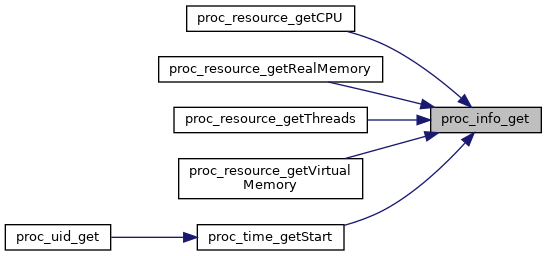
◆ proc_info_get()
| t_status proc_info_get | ( | t_pid | pid, |
| t_proc_info * | info | ||
| ) |
Obtain raw process information This is the function call that allows clients to make a single call and obtain all raw process data.
- Parameters
-
[in] pid - Process ID [out] info - Process information
- Returns
- Operation status
◆ proc_info_getCPUConsumption()
| t_status proc_info_getCPUConsumption | ( | t_proc_info * | info, |
| t_size * | size | ||
| ) |
Extract the process CPU consumption (summary of user and system) from the process information.
- Parameters
-
[in] info - Process information [out] size - Percentage of consumed process CPU
- Returns
- Operation status
◆ proc_info_getRealMemory()
| t_status proc_info_getRealMemory | ( | t_proc_info * | info, |
| t_size * | size | ||
| ) |
Extract the size of the process real memory, i.e. ram usage, from the process information.
- Parameters
-
[in] info - Process information [out] size - Real memory size in bytes
- Returns
- Operation status
◆ proc_info_getStartTime()
| t_status proc_info_getStartTime | ( | t_proc_info * | info, |
| t_time * | start | ||
| ) |
Extract the process start time from the process information.
- Parameters
-
[in] info - Process information [out] start - Process start time
- Returns
- Operation status
◆ proc_info_getThreads()
| t_status proc_info_getThreads | ( | t_proc_info * | info, |
| t_size * | number | ||
| ) |
Extract the number of process kernel threads / LWPs from the process information.
- Parameters
-
[in] info - Process information [out] number - Number of process threads
- Returns
- Operation status
◆ proc_info_getVirtualMemory()
| t_status proc_info_getVirtualMemory | ( | t_proc_info * | info, |
| t_size * | size | ||
| ) |
Extract the size of the process virtual memory from the process information.
- Parameters
-
[in] info - Process information [out] size - Virtual memory size in bytes
- Returns
- Operation status
◆ proc_instance_clone()
| t_status proc_instance_clone | ( | int * | isChild | ) |
Clone the current process.
- Parameters
-
[out] isChild - Child or father
- Returns
- Operation status
◆ proc_instance_create()
| t_status proc_instance_create | ( | t_proc * | proc | ) |
Create a new process instance.
- Parameters
-
[in,out] proc - process type
- Returns
- Operation status
◆ proc_instance_destroy()
| t_status proc_instance_destroy | ( | t_pid | pid, |
| int | forced | ||
| ) |
Terminate a running process.
- Parameters
-
[in] pid - The process to terminate [in] forced - Normal or forced termination
- Returns
- Operation status
◆ proc_instance_getChildStatus()
| t_status proc_instance_getChildStatus | ( | t_pid * | pid, |
| t_proc_status * | status | ||
| ) |
Obtain status of a child process.
- Parameters
-
[in] pid - Process ID [out] status - Status of child process
- Returns
- Operation status
◆ proc_instance_getNumberOfDescendents()
Obtain the number of children processes.
- Parameters
-
[in] pid - Get descendants of this process [out] number - Number of children processes
- Returns
- Operation status
◆ proc_instance_getNumberOfGroupMembers()
Obtain the number of process group members.
- Parameters
-
[in] pgid - The process group id [out] number - Number of process group members
- Returns
- Operation status
◆ proc_instance_getNumberOfSessionMembers()
Obtain the number of process session members.
- Parameters
-
[in] sid - The session id [out] number - Number of process group members
- Returns
- Operation status
◆ proc_instance_getState()
| t_status proc_instance_getState | ( | t_pid | pid, |
| int * | state | ||
| ) |
Obtain the state of a given process.
- Parameters
-
[in] pid - Process ID to check [out] state - The corresponding process state
- Returns
- Operation status
◆ proc_instance_getStatus()
| t_status proc_instance_getStatus | ( | t_pid | pid, |
| t_proc_status * | status | ||
| ) |
Obtain a status of a process.
- Parameters
-
[in] pid - Process ID [out] status - Status of child process
- Returns
- Operation status
◆ proc_instance_isRunning()
| t_status proc_instance_isRunning | ( | t_pid | pid | ) |
Is a process instance running.
- Parameters
-
[in] pid - Process ID to check
- Returns
- SUCCESS (Running) / FAILURE
◆ proc_instance_suspendExecution()
| t_status proc_instance_suspendExecution | ( | void | ) |
Suspend the execution of the current thread until an event occurs such as a signal in UNIX.
- Returns
- Operation status
◆ proc_instance_terminate()
| OSAPI_NORETURN void proc_instance_terminate | ( | int | code | ) |
Terminate the current process. It always succeeds.
- Parameters
-
[in] code - Exit status code
◆ proc_library_getAllLoaded()
Get a list of name and version information for each process loaded/shared library.
- Parameters
-
[in] maxlibs - Maximum size of the return arrays, i.e. name and version [out] info - Array with name and version of loaded libraries
- Returns
- Operation status
◆ proc_library_getNumberOfLoaded()
Get the number of shared libraries loaded in the process.
- Parameters
-
[out] maxlibs - Number of currently loaded libraries
- Returns
- Operation status
◆ proc_library_getRelease()
Get the Release information of the named library.
- Parameters
-
[in] name - Name of library to search [in] max - Max. size of the output string [out] release - The release version for the named library
- Returns
- Operation status
◆ proc_library_load()
| t_status proc_library_load | ( | char * | path, |
| char * | options[], | ||
| t_library * | lib | ||
| ) |
Load a library into the current process.
- Parameters
-
[in] path - Path to the library [in] options - C-String array with list of system specific options [out] lib - library type
- Returns
- Operation status
◆ proc_library_supported()
| t_status proc_library_supported | ( | void | ) |
Is the load/unload of libraries supported in the platform?
- Returns
- SUCCESS / FAILURE
◆ proc_library_unload()
| t_status proc_library_unload | ( | t_library | lib | ) |
Unload a library from the current process.
- Parameters
-
[in] lib - library type
- Returns
- Operation status
◆ proc_list_allocate()
Allocate memory in the HEAP for a list of items The "list" is implemented as an array of bytes.
- Parameters
-
[in] nItems - Number of items for the memory allocation [in] itemSize - Size, in bytes, of each item [out] list - List descriptor
- Returns
- Operation status
◆ proc_list_copy()
Copy two list memories List cannot overlap in any way (this generates an error)
- Parameters
-
[in] source - Address of the source list [out] target - Address of the target/destination list
- Returns
- Operation status
◆ proc_list_copyFrom()
| t_status proc_list_copyFrom | ( | const t_list * | source, |
| t_size | sourceItem, | ||
| t_size | targetSize, | ||
| void * | target | ||
| ) |
Copy from a list item to a naked/raw memory location.
- Parameters
-
[in] source - Address of the source buffer [in] sourceItem - Item number to copy [in] targetSize - Size of destination memory buffer [out] target - Raw destination memory address
- Returns
- Operation status
◆ proc_list_copyTo()
| t_status proc_list_copyTo | ( | const void * | source, |
| t_size | sourceSize, | ||
| t_size | targetItem, | ||
| t_list * | target | ||
| ) |
Copy from a naked/raw memory into a list item.
- Parameters
-
[in] source - Raw source memory address [in] sourceSize - Size of the source memory content [in] targetItem - Item number to copy into [out] target - List descriptor
- Returns
- Operation status
◆ proc_list_deallocate()
Deallocate list.
- Parameters
-
[in] list - List descriptor
- Returns
- Operation status
◆ proc_list_getCapacity()
Get the list capacity in terms of allocated items.
- Parameters
-
[in] list - List descriptor [out] size - List capacity
- Returns
- Operation status
◆ proc_list_getData()
Get the memory address of a given data item (of a list)
- Parameters
-
[in] list - List descriptor [in] item - Item number for which the address is needed [out] data - Address of the managed naked/raw HEAP memory
- Returns
- Operation status
◆ proc_list_getRequiredCapacity()
Get the required list capacity in terms of allocated items The required capacity is needed in case a list is not big enough to hold all elements.
- Parameters
-
[in] list - List descriptor [out] size - List required capacity
- Returns
- Operation status
◆ proc_list_getSize()
Get the current list usage in terms of number of items.
- Parameters
-
[in] list - List descriptor [out] size - List usage size
- Returns
- Operation status
◆ proc_list_hasCapacity()
Check if the list can store N items.
- Parameters
-
[in] list - List descriptor [in] size - Required capacity from list
- Returns
- Success if enough capacity, error status otherwise
◆ proc_list_reAllocate()
Resize a list of items.
- Parameters
-
[in] nItems - New number of items [out] list - List descriptor
- Returns
- Operation status
◆ proc_list_setRequiredCapacity()
Set the current list required capacity The required capacity is needed in case a list is not big enough to hold all elements.
- Parameters
-
[in] size - New list required capacity [in,out] list - List descriptor
- Returns
- Operation status
◆ proc_list_setSize()
Set the current list usage.
- Parameters
-
[in] size - New list usage size [in,out] list - List descriptor
- Returns
- Operation status
◆ proc_memory_allocate()
Allocate memory in the process heap.
- Parameters
-
[in] size - Required memory size in bytes [in] type - How likely is the memory to be reallocated? Hint to the memory manager [out] mem - Memory descriptor
- Returns
- Operation status
◆ proc_memory_copy()
Copy between two memories using memory descriptors.
- Parameters
-
[in] source - Memory to be copied [out] target - Destination of the copy
- Returns
- Operation status
◆ proc_memory_copyFrom()
Copy from a memory descriptor into a raw memory.
- Parameters
-
[in] source - Memory to be copied [in] targetSize - Size of the allocated memory destination [out] target - Destination of the copy
- Returns
- Operation status
◆ proc_memory_copyTo()
Copy from a raw source memory into a memory descriptor.
- Parameters
-
[in] source - Raw memory to be copied [in] sourceSize - Size of the allocated source memory [out] target - Destination of the copy
- Returns
- Operation status
◆ proc_memory_deallocate()
Deallocate a previously allocated heap memory block.
- Parameters
-
[in] location - Address of the new memory block
- Returns
- Operation status
◆ proc_memory_getCapacity()
Retrieve the total allocated memory size, in bytes.
- Parameters
-
[in] mem - Memory descriptor [out] size - Currently allocated memory size in bytes for the provided descriptor
- Returns
- Operation status
◆ proc_memory_getData()
Get the raw memory address for the given memory descriptor.
- Parameters
-
[in] mem - Memory descriptor [out] data - Raw memory address (data contents)
- Returns
- Operation status
◆ proc_memory_reAllocate()
Resize the previously allocated memory in the process heap.
- Parameters
-
[in] newSize - New memory size in bytes [in,out] mem - Memory descriptor
- Returns
- Operation status
◆ proc_module_supported()
| t_status proc_module_supported | ( | void | ) |
Is PROC module supported in the platform.
- Returns
- True if supported. False, otherwise (using status macros)
◆ proc_rawMemory_allocate()
Allocate memory in the process heap.
- Parameters
-
[in] size - Required memory size in bytes [in] type - How likely is the memory to be reallocated? Hint to the memory manager [out] mem - Memory pointer
- Returns
- Operation status
◆ proc_rawMemory_deallocate()
| t_status proc_rawMemory_deallocate | ( | void * | mem | ) |
Deallocate a previously allocated heap memory block.
- Parameters
-
[in] mem - Address of the memory to deallocate
- Returns
- Operation status
◆ proc_rawMemory_reAllocate()
Resize the previously allocated memory in the process heap.
- Parameters
-
[in] newSize - New memory size in bytes [in,out] mem - Memory pointer
- Returns
- Operation status
◆ proc_resource_getCPU()
Get the process CPU consumption (summary of user and system)
- Parameters
-
[in] pid - Process ID [out] size - Percentage of consumed process CPU
- Returns
- Operation status

◆ proc_resource_getRealMemory()
Get the size of the process real memory, i.e. ram usage.
- Parameters
-
[in] pid - Process ID [out] size - Real memory size in bytes
- Returns
- Operation status

◆ proc_resource_getThreads()
Get the number of process kernel threads / LWPs.
- Parameters
-
[in] pid - Process ID [out] number - Number of process threads
- Returns
- Operation status

◆ proc_resource_getVirtualMemory()
Get the size of the process virtual memory.
- Parameters
-
[in] pid - Process ID [out] size - Virtual memory size in bytes
- Returns
- Operation status

◆ proc_signal_clearAll()
| t_status proc_signal_clearAll | ( | void | ) |
Unblock of all signals. If there are any blocked signal, these will be unblocked.
- Returns
- Operation status
◆ proc_signal_getName()
Get the name of a signal The function maps a signal number to a signal name.
- Parameters
-
[in] sigNumber - The POSIX signal constant (e.g. SIG_TERM) [out] sigName - The POSIX signal name (e.g. "SIG_TERM")
- Returns
- Operation status
◆ proc_signal_getNumber()
Get the name of a signal The function maps a signal number to a signal name.
- Parameters
-
[in] sigName - The POSIX signal name (e.g. "SIG_TERM") [out] sigNumber - The signal number
- Returns
- Operation status
◆ proc_signal_resetHandler()
| t_status proc_signal_resetHandler | ( | t_signal | sigNumber | ) |
Reset a signal to the default behavior.
- Parameters
-
[in] sigNumber - The POSIX signal constant (e.g. SIG_TERM)
- Returns
- Operation status
◆ proc_signal_resetHandlerByName()
Reset a signal to the default behavior.
- Parameters
-
[in] sigName - The POSIX signal name (e.g. "SIG_TERM")
- Returns
- Operation status
◆ proc_signal_send()
| t_status proc_signal_send | ( | t_pid | pid, |
| t_signal | sigNumber | ||
| ) |
Send a signal to a process The signal identifier will be the standard POSIX constant SIG_xxx.
- Parameters
-
[in] pid - Target Process ID [out] sigNumber - Signal identifier
- Returns
- Operation status
◆ proc_signal_sendByName()
Send a signal to a process The signal identifier will be the standard POSIX name "SIG_xxx".
- Parameters
-
[in] pid - Target Process ID [out] sigName - Signal name
- Returns
- Operation status
◆ proc_signal_setHandler()
| t_status proc_signal_setHandler | ( | t_signal | sigNumber, |
| t_sig_func | sigFunc | ||
| ) |
Set a signal handler function for a given signal number.
- Parameters
-
[in] sigNumber - The POSIX signal constant (e.g. SIG_TERM) [out] sigFunc - The function name/address
- Returns
- Operation status
◆ proc_signal_setHandlerByName()
Set a signal handler function for a given signal name.
- Parameters
-
[in] sigName - The POSIX signal name (e.g. "SIG_TERM") [out] sigFunc - The function name/address
- Returns
- Operation status
◆ proc_signal_supported()
| t_status proc_signal_supported | ( | int * | supportLevel | ) |
Are signals supported by the OSAPI library?
- Parameters
-
[out] supportLevel - The level of support may vary, for instance, standard POSIX signals may be supported but not real time signals.
- Returns
- Operation status
◆ proc_time_getStart()
Get the start time of a process.
- Parameters
-
[in] pid - Process ID [out] start - Process start time
- Returns
- Operation status


◆ proc_uid_get()
Get the current process Unique ID A Process Unique ID is a unique incarnation of a process instance, i.e. no two processes will have the same UPID in the same node.
- Parameters
-
[out] upid - The process Unique ID
- Returns
- Operation status