The OSAPI status module. More...

Typedefs | |
| typedef int | t_status_type |
| Library identifier type (OSAPI, libc, etc.) | |
| typedef struct osapi_status_S | t_status |
| The status type. | |
Functions | |
| void | status_instance_clear (t_status *status) |
| Reset the status type. More... | |
| void | status_instance_set (t_module module, t_status_type type, t_status_funcname funcname, t_error error, t_status *status) |
| Set the status type with the current status information using an error code. More... | |
| void | status_instance_setString (t_module module, t_status_type type, t_status_funcname funcname, t_status_string errorString, t_status *status) |
| Set the status type with the current status information using an error string. More... | |
| void | status_message_print (t_status status) |
| Write a message with the status information to Standard output. More... | |
| void | status_message_retrieve (t_status status, t_size size, t_char *message) |
| Get the status information into a message string. More... | |
| const char * | status_module_get (t_status status) |
| Get the module name that corresponds to the provided status information. More... | |
| const char * | status_function_get (t_status status) |
| Get the function name that corresponds to the provided status information. More... | |
| const char * | status_message_get (t_status status) |
| Get the error message that corresponds to the provided status information. More... | |
| bool | status_success_is (t_status status) |
| Obtain the result of an operation This call is needed since the status_success macro may not be available in other programming languages. More... | |
| void | osapi_trace (const char *func, const char *sep, uint64_t line, const char *fmt,...) |
| OSAPI C Trace function - This function sends the output to standard error. More... | |
| void | osapi_status_trace (const char *func, uint64_t line, t_status st) |
| OSAPI C General Trace function - The function sends the output to standard error. More... | |
Variables | |
| const typedef char * | t_status_string |
| Error string type. | |
| const typedef char * | t_status_funcname |
| Function name type. | |
Detailed Description
The OSAPI status module.
Function Documentation
◆ osapi_status_trace()
| void osapi_status_trace | ( | const char * | func, |
| uint64_t | line, | ||
| t_status | st | ||
| ) |
OSAPI C General Trace function - The function sends the output to standard error.
- Parameters
-
[in] func - Name of function [in] line - Line number [in] st - An operation status

◆ osapi_trace()
| void osapi_trace | ( | const char * | func, |
| const char * | sep, | ||
| uint64_t | line, | ||
| const char * | fmt, | ||
| ... | |||
| ) |
OSAPI C Trace function - This function sends the output to standard error.
- Parameters
-
[in] func - Name of function [in] sep - Separator between function and line number [in] line - Line number [in] fmt - printf format for the remaining arguments
OSAPI C Trace function - This function sends the output to standard error.
- Parameters
-
[in] func - Function name [in] sep - Separator string [in] line - Code line number [in] fmt - Message format specifier

◆ status_function_get()
| const char* status_function_get | ( | t_status | status | ) |
Get the function name that corresponds to the provided status information.
- Parameters
-
[in] status - Status information
- Returns
- Function name

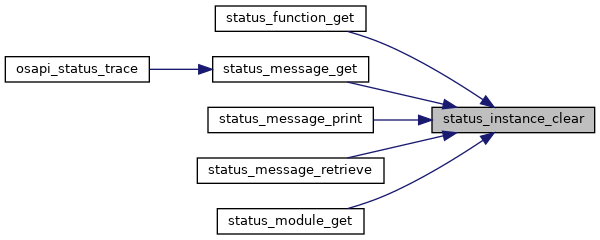
◆ status_instance_clear()
| void status_instance_clear | ( | t_status * | status | ) |
Reset the status type.
- Parameters
-
[out] status - status type
◆ status_instance_set()
| void status_instance_set | ( | t_module | module, |
| t_status_type | type, | ||
| t_status_funcname | funcname, | ||
| t_error | error, | ||
| t_status * | status | ||
| ) |
Set the status type with the current status information using an error code.
- Parameters
-
[in] module - Set the status module [in] type - Library information (OSAPI, libc, dl, etc) [in] funcname - Name of the function for which status is being provided [in] error - Error reported [out] status - status type
◆ status_instance_setString()
| void status_instance_setString | ( | t_module | module, |
| t_status_type | type, | ||
| t_status_funcname | funcname, | ||
| t_status_string | errorString, | ||
| t_status * | status | ||
| ) |
Set the status type with the current status information using an error string.
- Parameters
-
[in] module - Set the status module [in] type - Library information (OSAPI, libc, dl, etc) [in] funcname - Name of the function for which status is being provided [in] errorString - String with the error information [out] status - status type
◆ status_message_get()
| const char* status_message_get | ( | t_status | status | ) |
Get the error message that corresponds to the provided status information.
- Parameters
-
[in] status - Status information
- Returns
- Error string


◆ status_message_print()
| void status_message_print | ( | t_status | status | ) |
Write a message with the status information to Standard output.
- Parameters
-
[in] status - Status information

◆ status_message_retrieve()
Get the status information into a message string.
- Parameters
-
[in] status - Status information [in] size - Size of the message string [out] message - String with the status information

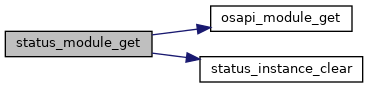
◆ status_module_get()
| const char* status_module_get | ( | t_status | status | ) |
Get the module name that corresponds to the provided status information.
- Parameters
-
[in] status - Status information
- Returns
- Module name
◆ status_success_is()
| bool status_success_is | ( | t_status | status | ) |
Obtain the result of an operation This call is needed since the status_success macro may not be available in other programming languages.
- Parameters
-
[in] status - Status information
- Returns
- True if operation was successful. False otherwise.